In its 50th anniversary year, Theatres Trust is marking the 20th year of the Theatres at
Risk Register by highlighting both encouraging progress and continuing challenges
for theatres across the UK.
The 2026 Theatres at Risk Register comprises of 39 theatres across the UK under
threat of closure, redevelopment or severe decay, which all have the potential to be
revived for their local communities with the right support.
Two theatres, Abbeydale Picture House and Leith Theatre, are being removed from
this year’s Register as significant progress has been made towards their respective
restoration and reopening. These two theatres are no longer deemed ‘at risk’ by the
national advisory body for heatres. Abbeydale Picture House reopened its basement
space as a lounge and bar with plans for the rest of the building to be reopened soon
as a vibrant entertainment venue, hosting live music, comedy and other events. With
Theatres Trust’s support Leith Theatre Trust has secured significant funding towards
restoring the building and has appointed a design team to start the major capital
project. Theatres Trust has provided expert, impartial advice to both theatres at
every step of their respective journeys and will continue to support them as they
progress through their business development and work towards being able to fully
reopen.
There are two new additions to the Theatres at Risk Register. Preston Guild Hall is
the only professional theatre in the city and has been closed since 2019, initially due
to legal disputes and more recently as due to the discovery of ‘crumbling concrete’
RAAC in the roof of the Great Hall and Chapter Theatre. The Forum in Barrow-in
Furness closed due to asbestos both in the theatre and the connected building,
which has led to proposals of demolition. With no plans for a replacement, this would
leave Barrow without a theatre. Both Preston Guild Hall and The Forum are local
authority-owned theatres built in the 1970s.
Joshua McTaggart, CEO of Theatres Trust says “We are delighted to say that
Abbeydale Picture House and Leith Theatre are no longer considered at risk. Their
inclusion on the Theatres at Risk Register achieved its purpose, raising awareness
to build local support and help unlock funding for these special theatres. Removing
them from the Register is not the end of the journey and there is still work to be done
to ensure their long-term resilience. Theatres Trust will be there to support both
organisations with the operational challenges they may face as they move towards
fully reopening.
“While it is fantastic to celebrate these successes in our 50th anniversary year, we
must temper that with the reality that we are also adding two more theatres to the
Register. That means two more communities losing access to the joy and
opportunities that theatre brings. Sadly, these buildings are just the tip of the iceberg,
and we are beginning to identify a potential trend for theatres built in the 1970s now
facing a higher likelihood of challenges that could lead to long-term or even
permanent closure. Without sustained long-term support for theatres at the local,
regional, and national level, we could see many more theatres from the 70s added to
our Theatres at Risk Register. This is a future we want to confidently avoid, and so
Theatres Trust urges theatre owners, operators and local authorities to reach out to
us before concerns become crises.”
First launched in 2006, the Theatres at Risk Register shines a spotlight on theatres
under threat and helps galvanise support for securing their future. Over two decades,
this campaign has played a vital role in raising awareness, building partnerships, and
supporting the revival of important cultural assets in communities across the country.
In the intervening two decades, more than 80 theatres have been restored and
revived, or suitable replacements have been built. Notable success stories include
Bradford Live, Stockton Globe, Walthamstow Granada and Wilton’s Music Hall.
Theatres Trust advocates for the whole of the UK’s theatre sector and provides a
range of services targeted to help theatre owners and operators to make the most of
their buildings and prevent them from becoming ‘at risk’.
Full case studies and assessment criteria can be seen on the Theatres Trust
website.
The theatres featuring on the 2026 list are:
Amulet Theatre, Shepton Mallet
Borough Hall, Greenwich
Brighton Hippodrome
Brunton Theatre
Burnley Empire
Clair Hall, Haywards Heath
Co-op Hall, Ramsbottom
Conwy Civic Hall (Cube)
Derby Hippodrome
Doncaster Grand
Epstein Theatre
The Forum, Barrow-in-Furness – NEW
Garrick Theatre, Southport
Garston Empire
Harlequin Theatre
Hulme Hippodrome
Imperial Theatre, Walsall
Intimate Theatre
Joe Longthorne Pavilion, Blackpool
King’s Theatre Dundee
Mechanics Institute, Swindon
Motherwell Concert Hall &Theatre
Netherton Arts Centre
Oswaldtwistle Civic Arts Centre & Theatre
Plymouth Palace
Preston Guild Hall – NEW
Prince of Wales, Cannock Chase
Regent Theatre, Great Yarmouth
Roundhouse Theatre, Dover
Spilsby Sessions House
Streatham Hill Theatre
Tameside Theatre, Ashton-under-Lyne
Thameside Theatre, Grays
Theatr Ardudwy, Harlech
Theatre Royal Margate
Theatre Royal, Manchester
Tottenham Palace Theatre
Victoria Theatre, Salford
Winter Gardens Morecambe
Notes to Editors
Website www.theatrestrust.org.uk/how-we-help/theatres-at-risk
BlueSky @TheatresTrust #TheatresAtRisk
Facebook /theatres.trust
Instagram @theatrestrust
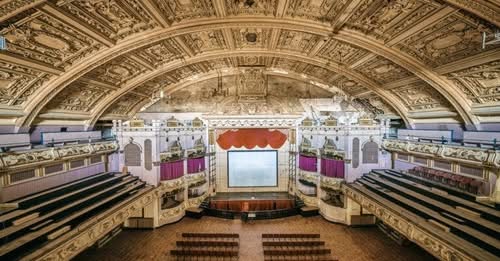
Photo Credit Leith Theatre, credit Gaelle Beri
Theatres Trust
Theatres Trust is the national advocacy body for the UK’s theatres supporting all
forms of theatres, whether old or new, commercial, subsidised or community-run.
We protect theatres and champion the future of live performance by advising and
supporting our nation’s theatres to develop best practice in design and management
following the four principles of resilience, environmental sustainability, inclusivity and
placemaking.
New additions to Theatres at Risk Register 2026:
The Forum, Barrow-in-Furness
Originally built as a civic centre in 1971, the Forum was adapted to become an arts
centre in 1990 and is Barrow’s only theatre. The Forum closed in July 2024 due to
the discovery of asbestos in the theatre, and then subsequent discovery of asbestos
in the connected Market Hall. Before its closure, The Forum was a popular venue
and the council had planned to invest £16m from the government’s Levelling Up fund
to improve the complex. However, the council has now announced plans to demolish
the entire site and there are no public plans or firm financial commitment to provide
an alternative venue for the town.
Preston Guild Hall
Opened in 1973, Preston Guild Hall was designed by Robert Matthew and Johnson
Marshall, founders of internationally renowned architecture firm RMJM. The only
professional theatre in Preston, it has hosted performances by acts including Bing
Crosby, Led Zeppelin, David Bowie and The Smiths. Originally owned by Preston
City Council, it was sold to a local businessman in 2014 to alleviate the council of
escalating operating and repair costs. Unfortunately, the business went into
administration and the building returned to council ownership as one of the creditors
in 2023. Plans to reopen it later that year stalled due to the discovery of ‘crumbling
concrete’ RAAC in the roof to the Great Hall and Chapter Theatre. While the council
considers various options for the building’s future ranging from refurbishment,
rebuilding on the same site or building a new venue elsewhere, the council is
programming events in the Guild Lounge, a temporary studio space formed in the
former Guild Hall Foyer.
Removed from Theatres at Risk Register 2026: Good news stories
Abbeydale Picture House
Grade II listed Abbeydale Picture House is a stunning 1920s’ cinema which was later
converted to cine-variety. It was added to the Theatres at Risk Register in 2024 when
maintenance issues and disputes between the operator and owner had led to its
closure. Its inclusion on the Theatres at Risk Register raised the profile of building
and its plight. In 2025 it was bought by True North Brewery, a company that has
experience of restoring and reopening other Sheffield venues. The Abbeydale
Ballroom in the venue’s basement has now reopened as a pool lounge, bar and
kitchen with plans for the rest of the building to be reopened soon as a vibrant
entertainment venue, hosting live music, comedy, art events, and food and drink
festivals. Theatres Trust has provided expert and impartial feedback on the owner’s
plans, alongside fundraising support. The vision and investment by the new owner
mean that Abbeydale Picture House is no longer considered to be ‘at risk’, although
Theatres Trust will continue to support True North Brewery.
Leith Theatre
Category B listed Leith Theatre opened in 1932, built for the people of Leith ‘as a gift
from the people of Edinburgh’, following the Burgh of Leith’s incorporation into
Edinburgh. Threatened by residential development and empty between 1988 and
2017, Leith Theatre was added to the Theatres at Risk Register in 2016 to raise its
profile. Theatres Trust has been working with Leith Theatre Trust as it gradually
restores the building and builds its organisational capacity. This support has included
a grant for mentoring and skills development to prepare the organisation to move
from a campaigning group to operating a venue. Having recently secured £5m over
three years from the City of Edinburgh Council Transient Tourist Levy, as well as
significant funding from The National Lottery Heritage Fund, , Leith Theatre is
moving closer to being fully reopened to provide spaces for the creative industries
and cultural performances, events and community programming. This important
milestone reflects the progress made over the last decade and marks the beginning
of a new chapter for Leith Theatre. The next stage of the project will focus on
developing detailed design plans, strengthening the organisation and securing the
remaining funding needed to support a National Lottery Heritage Fund Delivery
Phase application and, ultimately, the full restoration and reopening of Leith Theatre
as a permanent cultural and community asset. Although Leith Theatre is being
removed from the Register, Theatres Trust will continue to provide its impartial and
expert guidance to Leith Theatre Trust as it progresses through its major capital
project.
Removed due to changes in circumstances:
Four other theatres have been taken off the Register as changes to their
circumstances mean they are unlikely to return to live performance use.
Blackpool Winter Gardens Pavilion
Although the building needs investment and repairs, Theatres Trust is confident that
its owner Blackpool Council will not allow this historic building to deteriorate further.
Blackpool is already well served by Blackpool Grand Theatre, the Opera House in
the Winter Gardens and other live entertainment venues, and The Pavilion has also
undergone some alteration including converting the stage area into a cafe, meaning
that the Winter Gardens is unlikely to return to theatrical use. Theatres Trust is
therefore removing it from the Theatres at Risk Register.
The Globe, Plymouth
Similarly to Blackpool Winter Gardens, The Globe’s owner, the Ministry of Defence
(MoD) has committed to carry out works that will protect the theatre building from
immediate risk. However, as it is located on an MoD site, it is unlikely to return to use
as a public performance space in the foreseeable future, and is therefore being
removed from the Theatres at Risk Register.
The Groundlings, Portsmouth
Although a significant historic building, The Groundlings was originally built as a
school, which included a public hall for live entertainment. The organisation that was
operating it as a theatre has relocated to another venue in the city. Therefore,
Theatres Trust’s support will be focused on helping the operator in its new location
and will pass on concerns about the future The Groundlings to heritage
organisations who are better placed to protect it.
King’s Theatre, Kirkcaldy
The condition of the building has deteriorated significantly with demolition being
proposed to make the site safe. There is no longer the same level of local support or
demand for the King’s to be returned to theatre use as there was when it was first
added to the Theatres at Risk Register, with local audiences much better catered for
by the recently renovated Adam Smith Theatre and the smaller venue on the
esplanade located behind and named after the Kings Theatre Kirkcaldy
All enquiries, high res images and further information:
Georgina Carter, Chloé Nelkin Consulting
E: georgina@chloenelkinconsulting.com, T: 020 3627 2960
W: www.chloenelkinconsulting.com